The mysterious doodles hidden in a 1,300-year-old book
20/09/2026
Around 1,300 years ago, a woman leant over a precious book, and etched some letters into the margin, along with some cartoonish drawings. She didn't use ink – she scratched them in, so they were almost invisible to the naked eye.
Until last year, no-one knew they were there.
The 8th-Century book – a copy of the Act of Apostles from the Christian New Testament – is now kept in the Bodleian Library in Oxford. Researchers have known for a while that the religious text was probably owned by a woman, but they weren't sure who.
In 2022, the researcher Jessica Hodgkinson at the University of Leicester decided to take a closer look, and was surprised to find a hidden etching on page 18, just below the Latin text.
When digitally highlighted, it looked like this:
Archiox/Bodleian Library
The hidden etching that sparked further investigation (Credit: Archiox/Bodleian Library)
The letters read: "EaDBURG BIREð CǷ….N", with the last word incomplete. What could it mean?
Hodgkinson figured that the first symbol was a cross, followed by "Eadburg": almost certainly the name of the book's owner. Further analysis revealed it had been scratched deliberately with some form of stylus into four other pages.
Not much is known about her, but Hodgkinson and colleagues suspect that Eadburg was a nun – the abbess of a religious community at Minster-in-Thanet, in the English county of Kent.
The subsequent letters were a bit more enigmatic: could it mean "bears cwærtern" – the Old English word for "prison"? The Latin passage it accompanies describes the imprisonment of the Apostles, so Eadburg might have been drawing a parallel with her own situation.
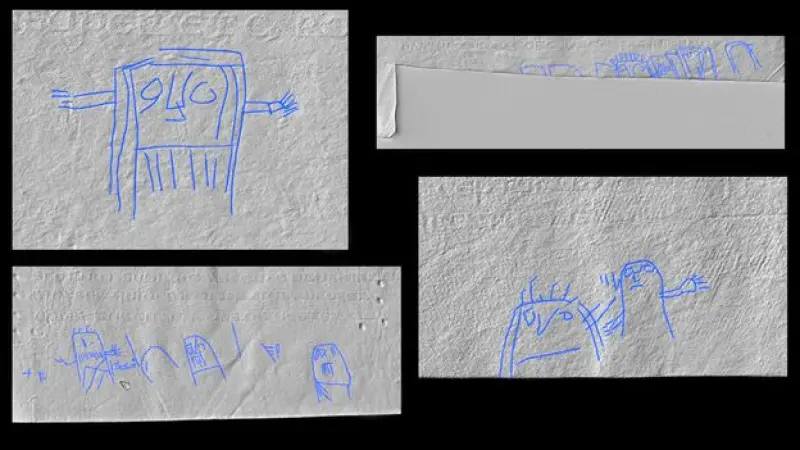
Even more intriguing, Hodgkinson and colleagues found drawings of little people on other pages. In one margin, a square figure with outstretched arms – could it be a nun perhaps? (see below, top-left). In another, a person holding up their hand to the face of glum companion (bottom-right). An 8th-Century version of "talk to the hand"? Their meaning is a mystery.
ADVERTISEMENT
Archiox/Bodleian Library
Doodles in the Eadburg book: was it the owner, or a mischievous child? It's a mystery (Credit: Archiox/Bodleian Library)
The marginalia inside the Eadburg book is not the only example of hidden writing and drawing discovered in Oxford in recent months. Hodgkinson was able to see Eadburg's etchings thanks to a new imaging technology at the Bodleian Library, which can map the physical texture and contours of a book page, manuscript, or the surface of other historical objects such as printing plates. Doing this in fine detail reveals features that would otherwise be invisible to the eye or standard cameras.
"The surface itself carries a vast amount of information," explains Adam Lowe, founder of the Factum Foundation in Madrid, a non-profit which engineered the technology for the Bodleian as part of the Archiox project (Analysing and Recording Cultural Heritage in Oxford). "The more you can make that visible, the more really exciting discoveries are going to come out."
See full article on BBC